

Traditional retail asks you to make a bet before you have any evidence it will pay off. You buy stock upfront, based on your best guess about what will sell, and then you hope. If the guess is right, you make money. If it is wrong, you own a garage or storage unit full of product that has to be discounted, donated, or thrown away — and either way, the cash you spent buying it is gone before you know whether the bet was any good.
There is a different model available to Shopify sellers in 2026, and it inverts that order entirely: you list a product in your store first, with no purchase and no commitment. You only pay for it — at your own cost, not retail — the moment a customer actually buys it. If nothing sells, you have spent nothing. This article is a plain, practical walk-through of exactly how that model works, how to set it up on Shopify, and what you actually control once it is running.
| Can you sell products without holding inventory? Yes. Shopify sellers can sell products without holding inventory by listing products first and paying only when a customer places an order. With Mysellerhub and Onlihub, products come from real inventory already stored in Amazon’s U.S. fulfillment network, and Amazon MCF handles fulfillment after the sale. |
How to Sell Products Online Without Inventory
The mechanics are simple enough to explain in three steps, and understanding them is the entire foundation for everything else in this article.
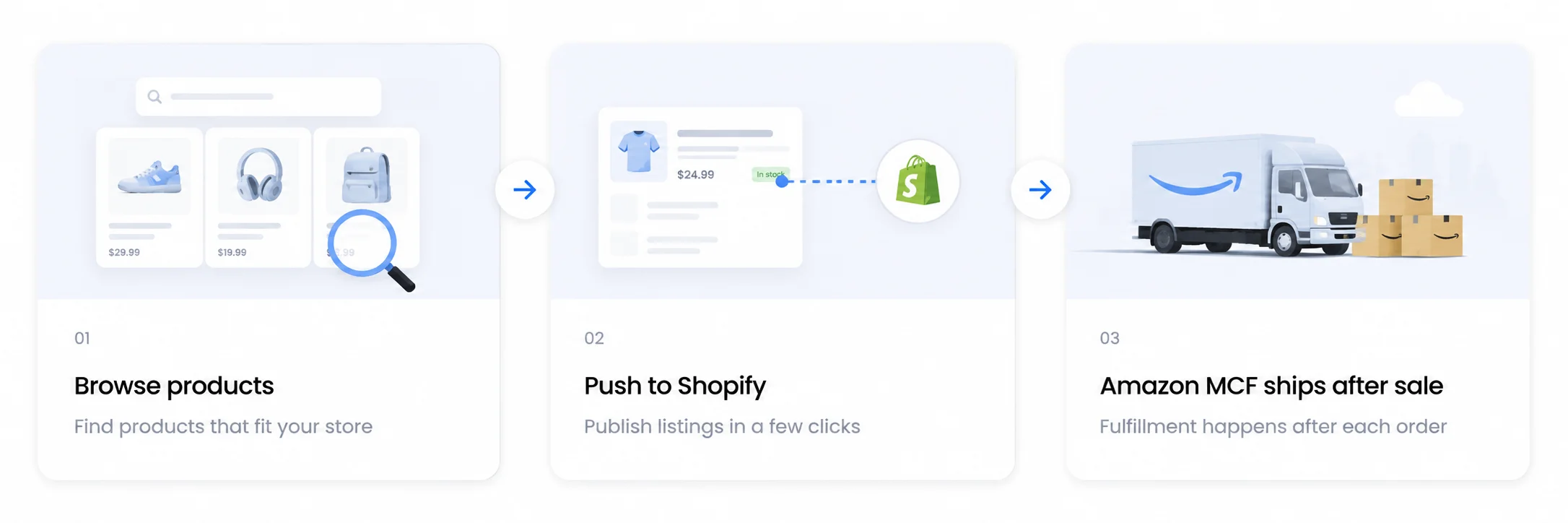
1. You list products in your store without buying them
You browse a catalog of available products — real branded items sitting in Amazon’s US fulfillment network — and choose which ones to add to your Shopify store. Adding a product to your store costs nothing. There is no purchase order, no minimum quantity, and no inventory sitting anywhere that belongs to you. The listing exists; the physical product has not changed hands.
2. When a customer orders, the unit ships from Amazon’s network
A customer visits your store, sees the listing exactly as they would see any other product you sell, and completes checkout. That order triggers Amazon Multi-Channel Fulfillment (MCF), which picks, packs, and ships the specific unit from the Amazon warehouse where it is already sitting — directly to your customer. You never touch the product. You never see a box. The fulfillment mechanics are identical to how Amazon ships its own orders, just triggered by a sale on your store instead of a sale on Amazon.com.
3. You pay only the cost per sold unit, no upfront commitment
This is the part that inverts the traditional retail risk entirely. You are charged for the unit — at a wholesale cost set by the brand, not the retail price you charge your customer — only after the sale has already happened and payment has already cleared. There is no inventory purchase, no minimum order, and no cost incurred on products that do not sell. Your margin is the gap between what you charge your customer and what the unit costs you, and that gap is known before you ever list the product.
| The core mechanic in one sentence: list first, pay only on a sale. Nothing is bought until something is sold. |
Who This Model Is For
This model is best for Shopify sellers who want to expand their catalog without buying stock upfront, new store owners who want to test product demand before committing capital, and growing retailers who need a faster alternative to overseas dropshipping. It is also useful for stores that already have traffic but need more products to test without creating inventory risk.
Why This Beats Classic Dropshipping
If you have researched dropshipping before, the no-inventory concept itself is not new — sourcing from overseas suppliers via AliExpress or similar platforms has worked this way for years. What is different here is where the inventory physically sits and what that does to your delivery times and your margin certainty. The previous article in this series covers why the classic overseas version of this model has been breaking down — 15 to 30 day delivery windows, rising customer complaints, and new duties on low-value imports that did not apply until recently. This model solves the same core problem, sourced from a different starting point.
Fast U.S. Shipping Through Amazon MCF
Because the products are already stored in Amazon fulfillment centers in the United States, orders can ship through Amazon MCF with Standard delivery in 3 business days and Expedited delivery in 2 business days, depending on the selected service level. Your customer is not waiting to find out if their order arrived from overseas intact. It ships the way orders from any major, established retailer ship, because functionally, it is being fulfilled by the same infrastructure that fulfills them.
Known Product Cost and Margin Before You List
Classic overseas dropshipping often means guessing at your true landed cost — product price, shipping, and now potentially duties, none of which are fully knowable until the order has already shipped. With this model, the wholesale cost per unit is fixed and visible before you ever add the product to your store. You know your margin with certainty at the moment you set your retail price, not after the fact.
No-Inventory Selling vs. Traditional Retail vs. Overseas Dropshipping
| Factors | Traditional retail | Overseas dropshipping |
| Upfront cost | Buy inventory before any sale | None |
| Delivery time | Fast — you control fulfillment | 15–30 days typical |
| Risk if it doesn’t sell | You own unsold stock | None — nothing was bought |
| Cost certainty before listing | Known, but capital is at risk | Variable — shipping and duties add up |
The no-inventory model built on domestic FBA inventory combines the upside of both columns: no upfront cost or ownership risk like dropshipping, with the fast, predictable delivery of traditional retail — because the product is already positioned close to your customer before they ever place the order.
How to Source Products for Shopify With Mysellerhub
Getting this running on an existing Shopify store takes minutes, not days. Here is the setup sequence using Mysellerhub, the free Shopify sourcing app built for exactly this workflow.
Install the app
Install Mysellerhub from the Shopify App Store. It is free to install, and there is no cost to browse the catalog or connect your store. The app is built by the same team behind Onlihub, which is the underlying network of Amazon FBA brands making their inventory available to independent retailers.
Connect your store
Authorize the app to connect to your Shopify store the same way you would install any other Shopify app — a standard permissions screen, a click to confirm, and the connection is live. No developer, no custom code, no separate account setup outside the app itself.
Pick a category
Browse the available product catalog and choose a category that fits your store’s existing focus, or one you want to test as a new direction. You are looking at real products from real Amazon-selling brands, with pricing already visible, so you can evaluate fit before committing to anything.
Push listings to your store
Select the specific products you want to sell and push them to your store. Titles, images, and descriptions transfer automatically — no manual data entry required. Within minutes, the products are live on your storefront, ready for a customer to find and buy.
How Pricing and Margin Work
For each product, you see the wholesale cost — what you will be charged when a unit sells — clearly displayed before you list it. You set your own retail price above that cost. The difference is your margin, and it is visible to you at the moment you decide on a price, not calculated after the fact. There is no hidden fee structure to reverse-engineer: cost per unit, your price, and the gap between them are all in front of you from the start.
What This Model Does Not Solve
Selling without inventory reduces upfront product risk, but it does not remove the need for good product selection, clear pricing, strong marketing, and a store that customers trust. You still need to choose products that fit your audience, set prices that leave room for margin, and drive traffic to your listings. The advantage is that you can test those decisions without buying inventory before you know what will sell.
Start Sourcing Fast-Shipping Products With Zero Inventory
The traditional retail bet — buy first, hope second — is not the only way to run a store anymore. Listing first and paying only when a customer buys removes the single biggest source of risk in starting or expanding a Shopify store: capital tied up in stock that might not move. Combined with domestic fulfillment speeds that overseas dropshipping cannot match, this is the cleanest version of the no-inventory retail model available right now.
Start sourcing fast-shipping products with zero inventory. Install Mysellerhub from the Shopify App Store, browse real products before you list, and only pay when a customer buys.
More in this series
Is Dropshipping Dead? How to Replace Slow Overseas Shipping
Amazon Multi-Channel Fulfillment: Delivery Speeds, Pricing, and How to Get Started
About Mysellerhub
Mysellerhub is a free Shopify app that connects your store to Onlihub’s catalog of real Amazon FBA brands. List products with no upfront purchase, pay only when a unit sells, and let Amazon Multi-Channel Fulfillment handle delivery in a few business days. Learn more at mysellerhub.com or install directly from the Shopify App Store.